

Back

A small dog sits on a red couch, looking towards the camera with its head tilted.](https://cdn.prod.website-files.com/663379b068243e81cd1bd4fd/667c15c9f851bf3b02bc3982_Overview.svg)


Back
industry


Back


Back


For the fourth consecutive year, Regology surveyed compliance, legal, and risk professionals to understand how regulatory compliance and its associated functions have been changing over time. With four years of data now available, patterns are more measurable, and the directive of where and how to improve your organization’s compliance is clearer.
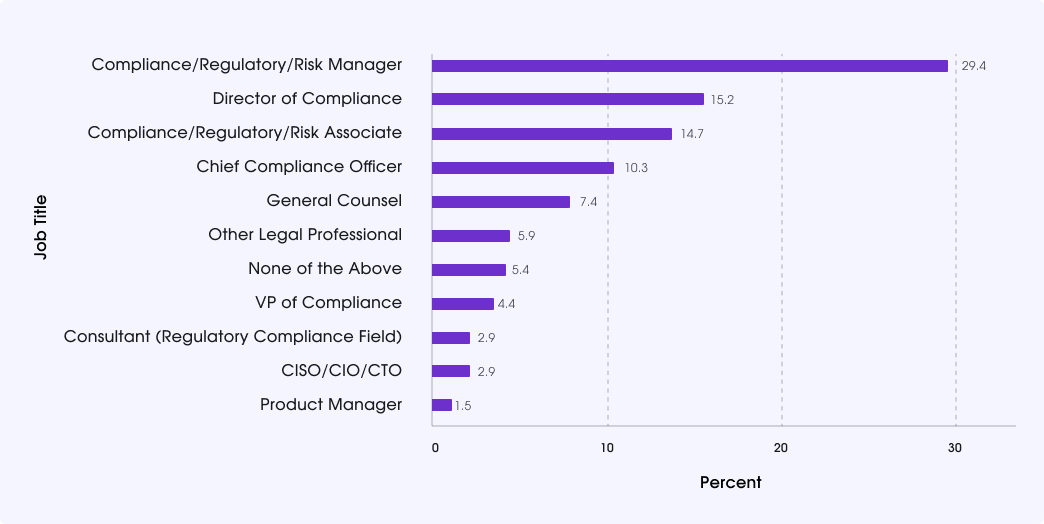
Based on responses from 204 compliance, legal, and risk professionals across different industries and organization sizes, this year’s survey paints a picture of a function operating at its limits. Compliance teams are being asked to absorb ever-more regulatory volume, manage more enforcement risk, and support broader business decisions, often without additional staff or new technology.
The result is a compliance environment at an inflection point, where a pivot towards tech-driven automation can bring significant change in workload and risk management.
One data point stands out immediately: 92.6% of respondents say their role has become more difficult over the past few years. This isn’t confined to a particular industry or company size. It reflects the reality that regulatory expectations are expanding in scope, speed, and complexity, while compliance teams are increasingly relied upon to translate that change into action across the organization.
For many professionals, it’s not driven by one-off regulatory events. It’s the constant state of change: overlapping rules, evolving guidance, and growing dependencies across legal, operations, IT, and risk. Complexity is no longer episodic but continuous.
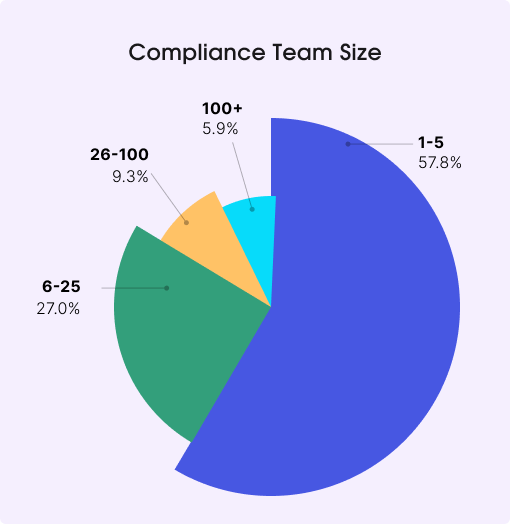
Despite rising expectations, compliance teams remain small. Nearly 58% of respondents work on teams of five people or fewer, and the median compliance function represents just ~1% of total organizational headcount.
This mismatch matters. When teams are lean, there is little buffer for absorbing new regulatory requirements, responding to audits, or dealing with enforcement issues. Headcount alone cannot scale fast enough to keep pace with regulatory growth, which means efficiency, process maturity, and technology increasingly determine whether teams can keep up or fall behind.
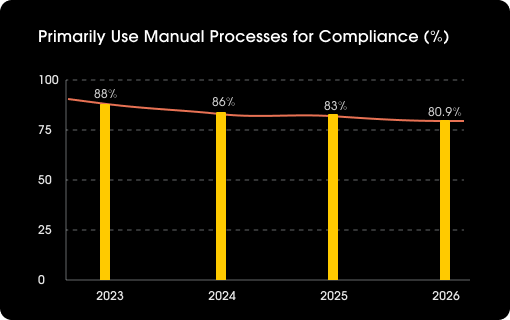
One of the most persistent findings in the survey is how manual compliance remains. More than 80% of respondents rely primarily on manual processes, and the same percentage still use spreadsheets to track compliance obligations. Automation levels remain relatively low.
This helps explain why administrative tasks, regulatory monitoring, and research are consistently cited as the least enjoyable parts of the job. These activities are repetitive, time-consuming, and difficult to scale, especially when regulatory change accelerates. Manual workflows may have worked when regulatory volume was lower, but they are increasingly strained under today’s exponential increase.
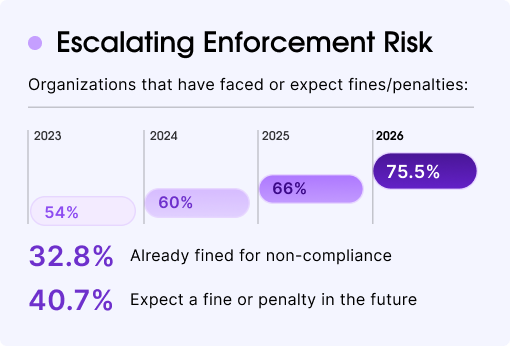
Perhaps the most sobering trend in the 2026 data is enforcement exposure. 32.8% of respondents report their organization has already faced fines or penalties, and 40.7% expect to face one in the future. Combined, 73.5% have either experienced or anticipate enforcement consequences.
This reflects a regulatory environment where scrutiny is active, and penalties are real. As enforcement risk rises, compliance leaders feel increased pressure to strengthen documentation, defensibility, and responsiveness—all while operating with limited capacity.
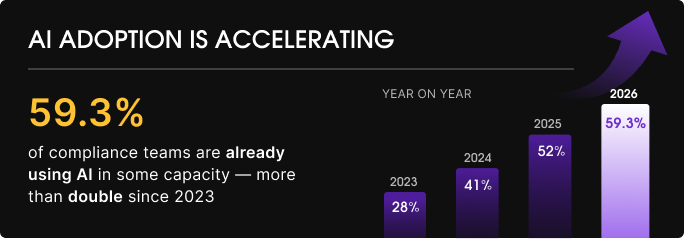
AI has moved from curiosity to reality inside compliance teams. 59.3% of respondents report already using AI in some capacity, and 75.5% say they are enthusiastic about using it. Over four years, AI adoption in compliance has more than doubled.
But this acceleration comes with tension. 38.8% of organizations still lack a formal AI risk review process, even as tools like ChatGPT and Copilot enter workflows informally. Accuracy, privacy, and confidentiality are top concerns, and compliance teams are acutely aware of the risk of relying on AI outputs without proper controls.
The message is clear: AI is becoming necessary to manage volume and speed, but governance is struggling to keep pace with adoption.
Even as teams proactively monitor for regulatory change, the underlying infrastructure remains fragmented. Most organizations do not maintain a formal law library, and many rely on dozens of regulatory sources. While 85.3% monitor regulatory updates, only 30.9% say the alerts they receive are always relevant.
This creates a hidden workload. Compliance teams spend significant time filtering noise before they can assess what actually matters. As regulatory volume grows, that imbalance slows response and increases operational risk.
While many of this year’s findings may feel familiar (lean teams, manual workflows, rising regulatory volume, and growing interest in technology), what the 2026 survey results bring to the fore is today’s gap between AI adoption in name and automation in practice. While more than half of respondents report using AI, and enthusiasm continues to rise, the day-to-day mechanics of compliance remain largely unchanged. More than 80% of teams still rely on manual processes, and many automate less than half of their compliance work.
This gap suggests that much of today’s AI usage is happening at the edges of compliance rather than at its core. General-purpose tools like ChatGPT may support research or drafting, but they do not replace the manual effort required to track regulatory change, assess applicability, manage obligations, or maintain audit-ready documentation. As a result, AI improves individual productivity without materially reducing operational load.
The consequence is a misleading signal. Teams appear to be “adopting AI,” yet automation across core compliance workflows is not advancing at a comparable pace. That disconnect helps explain why compliance roles continue to feel more difficult, even as new free tools enter the environment.
Simply put, AI alone is not enough. To meaningfully change how compliance operates, organizations need AI that is designed specifically for regulatory workflows—grounded in authoritative content, built with traceability and governance in mind, and embedded directly into monitoring, impact analysis, and execution processes.
In addition, the four-year trend data points to a broader transition: compliance is moving from a function centered on awareness to one defined by execution. The ability to quickly determine relevance, assess impact, and document defensible action is becoming the real differentiator.
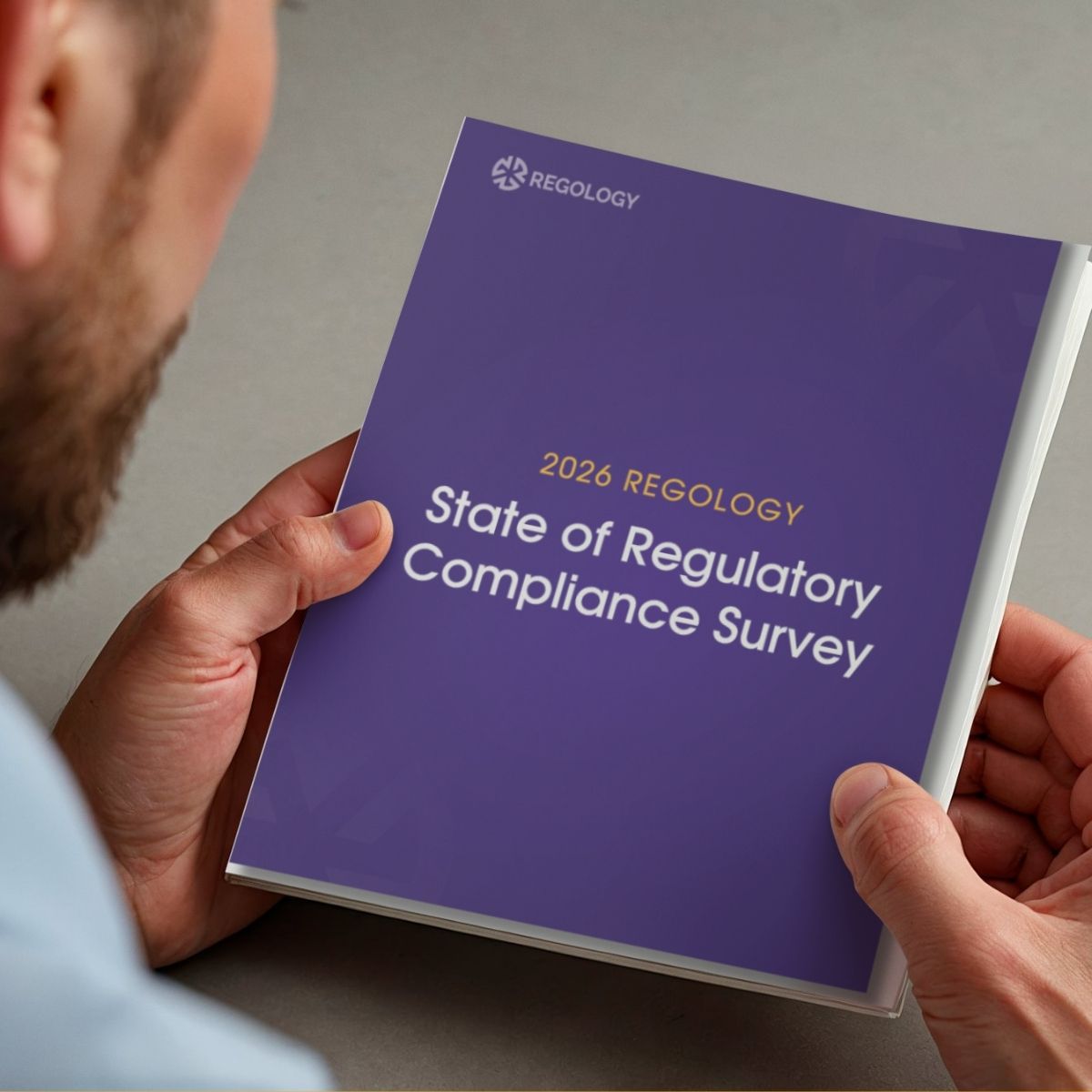
The full 2026 Regology State of Regulatory Compliance Survey explores these findings in depth, including four years of trend data, detailed breakdowns by role and organization size, and practical insights into how compliance teams are adapting.



Regology has been acquired by Bloomberg Industry Group, combining leading legal, tax and policy intelligence with regulatory AI.